There are certain movies that stay with you for reasons that have very little to do with their actual quality. They arrive at just the right moment in your life, introduce you to something new, and become part of your personal history. For me, Dan O’Bannon’s The Return of the Living Dead (1985) is one of those movies. I absolutely love it. Is it a great movie? Not particularly. Is it one of the most entertaining horror movies of its era? Without question.
I was at an age when horror movies were still something of an unexplored frontier, and The Return of the Living Dead helped introduce me to a world of zombies, gore, dark humor, and wonderfully ridiculous storytelling. It was scary without being overwhelmingly terrifying, funny without becoming a complete parody, and filled with memorable characters and dialogue that my friends and I would quote endlessly.
“Send more paramedics!”
“Brains!”
Those lines became part of our vocabulary. The movie had a wonderfully anarchic energy, a terrific punk-rock soundtrack, some genuinely impressive practical effects, and a cast that seemed to be having the time of their lives. It was gloriously stupid in all the right ways, and I mean that as a compliment.
The franchise that followed never quite captured that magic. Return of the Living Dead Part II was a fairly shameless attempt to recreate the original, while Return of the Living Dead 3 took the material in a decidedly different direction. Neither was particularly good, but I didn’t mind them. They were entertaining enough, and there was still something recognizable about the franchise.
The history of The Return of the Living Dead is actually rather interesting. George A. Romero and John A. Russo co-wrote the groundbreaking Night of the Living Dead in 1968, essentially establishing the modern zombie genre. Following their creative separation, Romero continued his zombie mythology with Dawn of the Dead and Day of the Dead, while Russo pursued his own continuation under the Return of the Living Dead name.
The project eventually found its way to Dan O’Bannon, who transformed the material into something entirely different. His zombies could run, talk, think, and, most famously, craved human brains. The film also cleverly acknowledged Night of the Living Dead as a movie, suggesting that Romero’s classic was based on actual incidents that had been covered up. It was a wonderfully creative approach that gave the movie its own distinct identity.
Which brings us to Return of the Living Dead: Aftermath, a movie that unfortunately seems to have forgotten nearly everything that made the original so entertaining.
I wasn’t expecting much from Aftermath. I certainly wasn’t expecting another 1985 classic. I would have been perfectly happy with a goofy, low-budget zombie movie that brought back a few familiar faces, offered some nostalgic callbacks, and delivered a handful of entertaining moments.
Instead, what we get is a disjointed, frequently incoherent production that relies so heavily on artificial intelligence that it barely holds together as a movie.
The circumstances surrounding Aftermath are almost as strange as the finished product. Written and directed by Richard Driscoll, the project reportedly originated as Trash’s Revenge, a proposed production involving original cast members Linnea Quigley and Beverly Randolph, who played Trash and Tina in the 1985 film.
According to interviews with the actresses, the finished production bears little resemblance to what they believed they were participating in. Quigley has said she withdrew before filming after learning about the extensive use of artificial intelligence, while Randolph reportedly filmed several days of material but was shocked by the digitally altered version of her performance in the finished movie.
I don’t pretend to understand the legal complexities surrounding the rights to this franchise, the contractual agreements with the performers, or precisely what permissions were granted. Those are matters for the people involved to resolve. But the controversy certainly doesn’t help a production that already has some serious problems.
And those problems are immediately apparent.
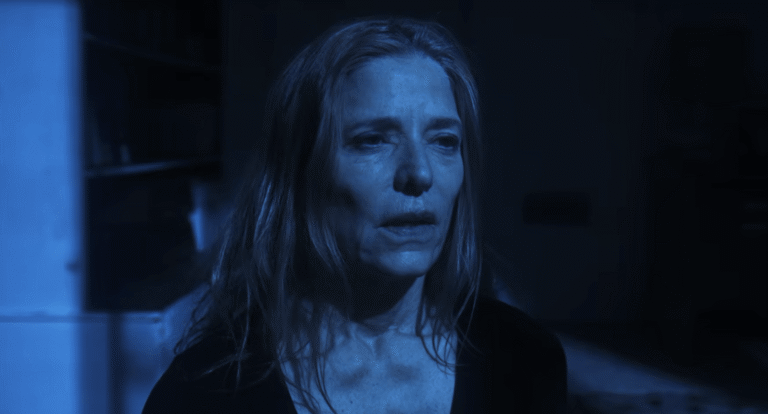
Return of the Living Dead: Aftermath is, unfortunately, an AI-generated mess. Scene after scene unfolds with little visual or narrative continuity. Characters and environments don’t consistently match from one shot to the next. Images have that unmistakable artificial quality associated with poorly executed generative AI, where everything looks vaguely cinematic but nothing feels grounded in an actual physical space.
The performances are frequently unnatural, the dialogue often sounds artificial, and the editing struggles to establish any meaningful rhythm. Sequences appear to exist simply because someone generated them, rather than because they contribute to a coherent narrative. The movie jumps from one moment to another without establishing a convincing sense of progression.
It’s like watching a collection of disconnected AI-generated horror clips that somebody attempted to assemble into a feature film.
I have no fundamental objection to filmmakers experimenting with artificial intelligence. Technology has always played an important role in filmmaking, and I’m genuinely interested in seeing how independent filmmakers might use these tools to expand their creative possibilities. But technology should serve the storytelling, not replace it.
And that’s where Aftermath falls apart.
A movie still needs characters, performances, pacing, continuity, and some semblance of a coherent story. Artificial intelligence doesn’t eliminate those requirements. If anything, the ability to generate an endless supply of imagery makes creative discipline even more important.
What makes this particularly disappointing is that the original Return of the Living Dead was never a franchise that demanded sophisticated storytelling or expensive production values. It worked because of its personality.
James Karen and Thom Mathews were hilarious as Frank and Freddy. Clu Gulager brought a wonderful sense of exasperation to Burt, Don Calfa was terrific as Ernie, and Linnea Quigley’s Trash became one of the most recognizable characters in 1980s horror. These weren’t particularly deep or complex characters, but they were memorable, entertaining, and wonderfully suited to the material.
Even the zombies had personality. The infamous Tarman remains one of the great practical monster creations of the era, and the movie’s combination of physical effects, dark comedy, and gleeful excess helped establish its devoted following.
None of this required perfection. It required imagination and an understanding of what made the material entertaining.
Aftermath has occasional flashes of imagery that might have worked in a more carefully constructed movie, and I can appreciate the desire to revisit a beloved cult franchise. But those fleeting moments aren’t nearly enough to overcome the fundamental problems with the production.
One thing I always try to do when reviewing a movie is find something worthwhile, even when the overall experience is disappointing. I’ve watched plenty of genuinely terrible movies over the years, and more often than not, there’s something redeemable. Maybe it’s an interesting performance, a clever idea, an ambitious filmmaker working with limited resources, or simply an entertaining moment that makes the experience worthwhile.
Sometimes a bad movie can still be a lot of fun. The Return of the Living Dead franchise itself is a pretty good example of that.
Unfortunately, Aftermath gives me very little to work with.
There may have been an interesting concept somewhere in the original production, and the involvement of familiar cast members certainly offered some potential. But whatever those intentions were, they are almost completely lost in the finished movie.
Instead of a nostalgic celebration of a cult classic, we’re left with a production that feels unfinished, visually inconsistent, and narratively confused. It’s difficult to become invested in characters who don’t seem to exist convincingly from one scene to the next, and even more difficult to care about a story that struggles to maintain any sense of continuity.
I suspect we’ll see plenty more productions like Aftermath as generative AI becomes increasingly accessible. Some will undoubtedly be interesting, and talented filmmakers will find creative ways to incorporate the technology into legitimate filmmaking. But Aftermath is a reminder that generating images and making a movie are two very different things.
I genuinely wanted to enjoy this one, or at least find enough entertaining moments to justify its existence. I didn’t need another classic. A silly, reasonably coherent zombie movie would have been more than enough.
Unfortunately, Return of the Living Dead: Aftermath is neither particularly entertaining nor especially coherent. It’s a disappointing attempt to revive a franchise that deserved a little more care and creativity.
There’s a certain irony in a series built around bringing the dead back to life producing a sequel that demonstrates why some things are better left buried.
Return of the Living Dead: Aftermath is a disappointing, AI-heavy resurrection of a beloved cult franchise. Despite some nostalgic potential, its inconsistent visuals, disjointed storytelling, and artificial performances leave very little worth recommending.