
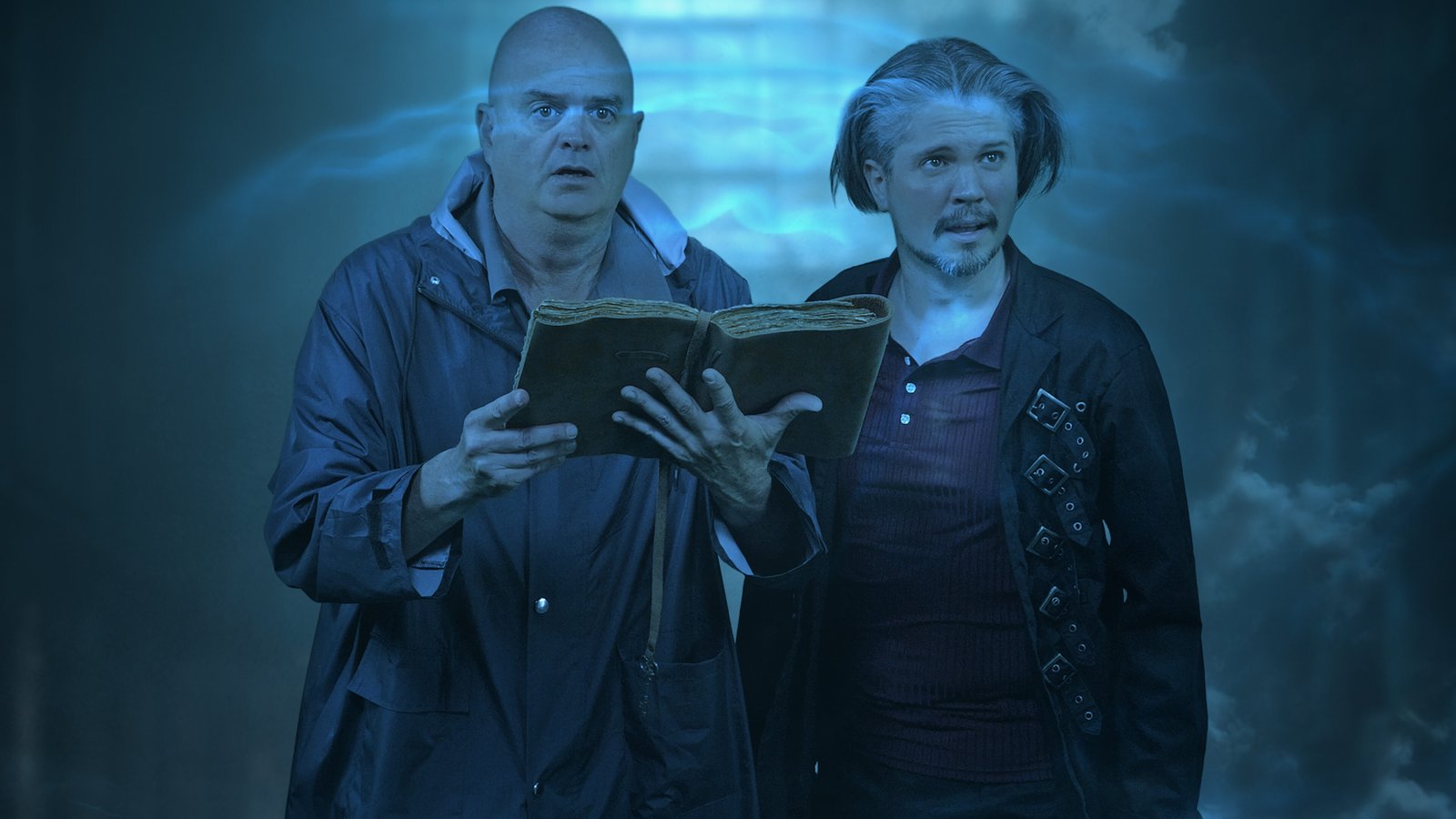
H.P. Lovecraft’s imagination has inspired generations of horror filmmakers, but adapting his work has always presented an interesting challenge. His stories are filled with forbidden knowledge, ancient gods, questionable scientific experiments, and the terrifying realization that humanity might be little more than an afterthought in a vast and indifferent universe. Bringing those ideas to the screen without losing their strange, unsettling appeal is no small task. Beyond the Abyss approaches that challenge with enthusiasm, taking familiar Lovecraftian ingredients and mixing them into an entertaining supernatural horror adventure that clearly has ambitions beyond a single movie.
At the center of the story is Herbert West, the infamous scientist whose obsession with overcoming death drives him into increasingly dangerous territory. Fans of Lovecraft will immediately recognize West from Herbert West–Reanimator, one of the author’s most accessible and darkly entertaining stories. Here, West’s reckless experimentation provides the foundation for something considerably larger. Rather than simply retelling the original story, Beyond the Abyss uses it as a doorway into the broader mythology of Lovecraft’s fictional universe.
And that’s where much of the fun begins.
There is something inherently entertaining about a brilliant scientist who is so convinced of his own genius that he cannot recognize the monstrous consequences of his actions. Herbert West is precisely that kind of character. His pursuit of immortality is equal parts scientific ambition, personal obsession, and spectacularly poor judgment. The film embraces that combination, allowing its horror to emerge not only from supernatural forces but also from the very human arrogance that sets everything in motion.
What makes Beyond the Abyss particularly interesting is its willingness to take creative liberties while remaining connected to its literary inspiration. This isn’t an exercise in faithfully reproducing every page of Lovecraft’s work, nor should it be. The filmmakers understand that the appeal of Lovecraft lies as much in the ideas behind his stories as in the individual plots. Forbidden experiments, mysterious texts, ancient powers, and the dangerous temptation to understand things that humanity was never meant to comprehend are all essential ingredients.
The film also makes effective use of the Necronomicon, that wonderfully ominous fictional book whose reputation has grown far beyond its original literary appearances. Its presence connects West’s experiments to something more sinister than ordinary scientific misconduct. Suddenly, the possibility of restoring life becomes part of a much larger and more disturbing cosmic equation.
Of course, anyone familiar with Lovecraft knows that opening the door to forbidden knowledge rarely ends well.
There is also an appealing sense that Beyond the Abyss is introducing us to a world rather than merely telling us a self-contained story. The characters and mythology suggest a broader universe waiting to be explored, with Herbert West serving as an accessible entry point. It’s a smart approach. Reanimation provides an immediate, tangible horror concept, while the larger Lovecraftian mythology offers almost limitless possibilities for future installments.
That doesn’t mean everything needs to be explained immediately. In fact, one of the pleasures of cosmic horror is the uncertainty. The less we understand about the forces lurking beyond the familiar world, the more unsettling they become. Beyond the Abyss works best when it allows those possibilities to hang over the story, reminding us that West’s experiments may be only a small part of something much more frightening.
The movie also benefits from not taking itself so seriously that it forgets to entertain. Lovecraftian horror can easily become an overly solemn affair, weighed down by elaborate mythology and endless exposition. Here, the combination of mad science, supernatural danger, and larger-than-life ambition gives the material a welcome sense of adventure. It is horror with a playful appreciation for its own outrageous possibilities.
Perhaps the film’s greatest strength is its understanding that adaptation and imitation are not the same thing. There is room for filmmakers to reinterpret Lovecraft, introduce new characters, rearrange familiar elements, and take the mythology in unexpected directions. What matters is preserving the spirit of the source material: the obsession with knowledge, the fragility of human existence, and the dreadful consequences of discovering that the universe is far stranger than we ever imagined.
Beyond the Abyss manages to honor those ideas while establishing an identity of its own.
As a standalone horror film, it offers an entertaining journey into the dangerous intersection of science and the supernatural. As the potential beginning of a larger series, it may be even more intriguing. There are countless corners of Lovecraft’s imagination left to explore, and the groundwork established here creates plenty of opportunities to venture into them.
Herbert West may be trying to bring the dead back to life, but Beyond the Abyss is interested in resurrecting something else as well: the excitement of discovering an entire world of strange creatures, forbidden secrets, and wonderfully unsettling possibilities.
For fans of Lovecraft, supernatural horror, and ambitious independent filmmaking, that’s a pretty appealing proposition.
Final Verdict: A fun, imaginative introduction to a larger Lovecraftian universe, Beyond the Abyss puts Herbert West and his dangerous experiments front and center while opening the door to future adventures in cosmic horror. It takes its own path without forgetting where it came from, and sometimes that’s exactly what a good adaptation should do.


